-
Edit -
Attach - Printable
- And... Action! (Part 2, 08 Sep 2009)
- "This software will crash Real Soon Now™. Promise!" (02 Sep 2009)
- How to Detect Mergers & Acquisitions in Code (01 Sep 2009)
- And... Action! (31 Aug 2009)
- A package riddle, part IV (28 Aug 2009)
- A package riddle, part III (22 Aug 2009)
- A package riddle, part II (20 Aug 2009)
- A package riddle (19 Aug 2009)
- STEP files for the masses (29 Jul 2009)
- What's in a name? (25 Jul 2009)
- I'd rather take it nice and slow - disabling 3D acceleration in CoCreate Modeling (15 Jul 2009)
- Common Lisp in CoCreate Modeling (20 Jun 2009)
- Aggressive predictions (03 May 2008)
- So long, and thanks for all the functional fish! (30 Mar 2008)
- Common Lisp at CoCreate (29 Dec 2007)
- What's my vector, Victor? (08 Aug 2007)
- I'm just a simple property list, I didn't expect the Spanish strinquisition! (19 Jul 2007)
- "Macro" considered harmful (01 May 2007)
- Die Kollegen Könige (21 Mar 2007)
- Don't quote me on this (18 Mar 2006)
- Two minute warning (16 Mar 2006)
- Comment dit-on "knapsack" en français? (01 Mar 2006)
- Blame CoCreate, for instance (14 Feb 2006)
- I'm so special (11 Feb 2006)
- Fingerpointing at smart pointers (31 Dec 2005)
And... Action! (Part 2, 08 Sep 2009)
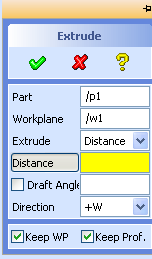 No, we don't need contrived constructs like (print extrude) to show that
extrude is somehow... different from all the other kids. All we need is a simple experiment.
First, enter extrude in
CoCreate Modeling's user input line: The Extrude dialog
unfolds in all its glory, and patiently awaits your input.
Now try the same with print: All you get is an uncooperative
"Lisp error: The variable PRINT is unbound". How disappointing.
But then, the behavior for print is expected, considering the usual
evaluation rules for Common Lisp,
particularly for symbols. As a quick reminder:
- If the symbol refers to a variable, the value of the variable is returned.
- If the symbol refers to a function and occurs in the first position of a list, the function is executed.
extrude & friends belong to the symbol jet-set in CoCreate Modeling. For them,
the usual evaluation rules for functions don't apply (pun intended).
Using symbol properties
as markers, they carry a backstage pass and can party anywhere.
For members of the extrude posse, it doesn't really matter if you use them as an
atom, in the first position of a list, or anywhere else: In all cases, the function which
they refer to will be executed right away - by virtue of an extension to the evaluator
which is unique to CoCreate Modeling's implementation of Common Lisp.
You can create such upper-class symbols yourself - using a macro called defaction.
This macro is also unique to CoCreate Modeling. Functions
defined by defaction are called, you guessed it, action routines.
But why, you ask, would I want such a feature, particularly if I know that it breaks with
established conventions for Lisp evaluation?
Well, precisely because this feature breaks with the established rules.
To be continued...
"This software will crash Real Soon Now™. Promise!" (02 Sep 2009)

 Fortunately, CoCreate Modeling has always had pretty elaborate crash handling mechanisms. Whenever an unexpected exception occurs, a top-level crash handler catches it, pops up a message describing the
problem, causes the current operation to be undone, restores the 3D model to a (hopefully) consistent
state, and returns the user to the interactive top-level loop so that s/he can save the
model before restarting.
Over time, we taught our crash handler to deal with more and more critical situations. (Catching stack overflows and multithreading scenarios are particularly tricky.) Hence, users rarely lose data in
CoCreate Modeling even if some piece of code crashes. Which pretty much obviates the need
for the proposed clairvoyance module.
Fortunately, CoCreate Modeling has always had pretty elaborate crash handling mechanisms. Whenever an unexpected exception occurs, a top-level crash handler catches it, pops up a message describing the
problem, causes the current operation to be undone, restores the 3D model to a (hopefully) consistent
state, and returns the user to the interactive top-level loop so that s/he can save the
model before restarting.
Over time, we taught our crash handler to deal with more and more critical situations. (Catching stack overflows and multithreading scenarios are particularly tricky.) Hence, users rarely lose data in
CoCreate Modeling even if some piece of code crashes. Which pretty much obviates the need
for the proposed clairvoyance module.
How to Detect Mergers & Acquisitions in Code (01 Sep 2009)


And... Action! (31 Aug 2009)
print and
CoCreate Modeling commands such as extrude differ and how they
interact, you've come to the right place.
Usually, I call a dialog like this: (set_pers_context "Toolbox-Context" function) Or like this: function As soon as I add parentheses, however, the "ok action" will be called: (function)
 When highway45 talks of "functions" here, he actually means commands like
 extrude or turn. So, (set_pers_context "Toolbox-Context" extrude)? Really? Wow!
set_pers_context is an internal CoCreate Modeling function dealing with
how UI elements for a given command are displayed and where. I was floored -
first, by the fact that an end user found a need to call an internal function like this,
and second, because that magic incantation indeed works "as advertised" by highway45.
For example, try entering the following in CoCreate Modeling's user input line:
(set_pers_context "Toolbox-Context" extrude)Lo and behold, this will indeed open the
Extrude dialog, and CoCreate Modeling
now prompts for more input, such as extrusion distances or angles.
What's so surprising about this, you ask? If you've used CoCreate Modeling for a while,
then you'll know that, as a rule of thumb, code enclosed in parentheses won't prompt
for more input, but will instead expect additional parameters in the command line itself.
For example, if you run (extrude) (with parentheses!) from the user input line, Lisp will
complain that the parameter "DISTANCE is not specified". But in highway45's example, there
clearly was a closing parenthesis after extrude, and yet the Extrude command started to
prompt!
So is set_pers_context some kind of magic potion? Try this:
(print extrude)The Extrude dialog opens and prompts for input! Seems like even
print has
magic powers, even though it's a plain ol' Common Lisp standard function!
Well, maybe there is something special about all built-in functions? Let's test this out and
try a trivial function of our own:
  (defun foobar() 42)
  (foobar extrude)
Once more, the dialog opens and awaits user input! So maybe it is neither of
set_pers_context, print or foobar that is magic - but instead extrude.
We'll tumble down that rabbit hole next time.
To be continued...
A package riddle, part IV (28 Aug 2009)
(defun test()
  (test_dialog))

(in-package :clausbrod.de)
(use-package :oli)

(sd-defdialog 'test_dialog
  :ok-action '(display "test_dialog"))
In part 3 of this mini-series, we figured out that the #: prefix indicates an uninterned symbol - and now we can solve the puzzle! Earlier, I had indicated that
sd-defdialog automatically exports dialog
names into the default package. To perform this trick, somewhere in the bowels of
the sd-defdialog macro, the following code is generated and executed:
(shadowing-import ',name :cl-user)  ;; import dialog name into cl-user package
(export ',name)                     ;; export dialog name in current package
(import ',name :oli)                ;; import dialog name into oli package
(export ',name :oli)                ;; export dialog name from the oli package
As a consequence, the dialog's name is now visible in three packages:
- The default package (
cl-user) - Our Lisp API package (
oli) - The package in which the dialog was defined (here:
clausbrod.de)
shadowing-import inserts each of symbols into package as an internal symbol, regardless of whether another symbol of the same name is shadowed by this action. If a different symbol of the same name is already present in package, that symbol is first uninterned from package.That's our answer! With this newly-acquired knowledge, let's go through our code example one more and final time:
(defun test()
  (test_dialog))
Upon loading this code, the Lisp reader will intern a symbol called
test_dialog into the current (default) package. As test_dialog has not
been defined yet, the symbol test_dialog does not have a value; it's just
a placeholder for things to come.
(in-package :clausbrod.de)
(use-package :oli)
We're no longer in the default package, and can freely use
oli:sd-defdialog without
a package prefix.
(sd-defdialog 'test_dialog
  :ok-action '(display "test_dialog"))
sd-defdialog performs (shadowing-import 'test_dialog :cl-user),
thereby shadowing (hiding) and uninterning the previously interned test_dialog symbol.
Until we re-evaluate the definition for (test), it will still refer to the
old definition of the symbol test_dialog, which - by now - is a) still without
a value and b) uninterned, i.e. homeless.
Lessons learned:
- Pay attention to the exact wording of Lisp error messages.
- The Common Lisp standard is your friend.
- Those Lisp package problems can be pesky critters.
(test) function would have saved
us all that hassle.
Phew.
A package riddle, part III (22 Aug 2009)
(defun test()
  (test_dialog))

(in-package :clausbrod.de)
(use-package :oli)

(sd-defdialog 'test_dialog
  :ok-action '(display "test_dialog"))
Load the above code, run
(test), and you'll get:
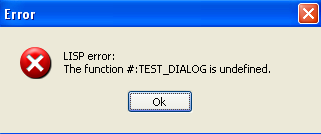
In CoCreate Modeling, the
sd-defdialog macro automatically exports the name of the new
dialog (in this case, test_dialog) into the default package. Hence, you'd expect that
the function (test), which is in the default package, would be able to call that dialog!
Astute readers (and CoCreate Modeling's Lisp compiler) will rightfully scold me for using
(in-package) in the midst of a file. However, the error doesn't go away if you split up
the above code example into two files, the second of which then properly
starts with (in-package). And in fact, the problem originally manifested itself in a
multiple-file scenario. But to make it even easier for readers to run the test themselves,
I just folded the two files into one.
Lisp actually provides us with a subtle hint which I ignored so far: Did you notice
that the complaint is about a symbol #:TEST_DIALOG, and not simply TEST_DIALOG?
The #: prefix adds an important piece to the puzzle. Apparently, Lisp thinks
that TEST_DIALOG is not a normal symbol,
but a so-called uninterned symbol. Uninterned symbols are symbols which don't
belong to any Lisp package - they are homeless. For details:
- Creating Symbols (from "Common Lisp the Language", 2nd edition)
- Programming in the Large: Packages and Symbols (from Peter Seibel's excellent "Practical Common Lisp")
- The Complete Idiot's Guide to Common Lisp Packages
- Potting Soil: Colons continued - uninterned symbols
TEST_DIALOG turned into an uninterned symbol. We would have expected it to
be a symbol interned in the clausbrod.de package, which is where the dialog is defined!
Those who are still with me in this series will probably know where this is heading.
Anyway - next time, we'll finally
solve the puzzle!
A package riddle, part II (20 Aug 2009)
(defun test()
  (test_dialog))

(in-package :clausbrod.de)
(use-package :oli)

(sd-defdialog 'test_dialog
  :ok-action '(display "test_dialog"))
Here is what happens if you save this code into a file, then load the file into CoCreate Modeling and call the
(test) function:
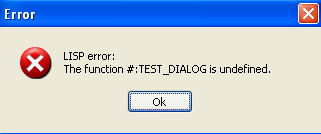
"The function #:TEST_DIALOG is undefined"? Let's review the code so that you can understand why I found this behavior surprising. First, you'll notice that the function
test is defined in the default Lisp package.
After its definition, we switch into a different package (clausbrod.de), in
which we then define a CoCreate Modeling dialog called test_dialog.
The (test) function attempts to call that dialog. If you've had any exposure with
other implementations of Lisp before, I'm sure you will say: "Well, of course the system
will complain that TEST_DIALOG is undefined! After all, you define it in package
clausbrod.de, but call it from the default package (where test is defined).
This is trivial! Go read
The Complete Idiot's Guide to Common Lisp Packages
instead of wasting our time!"
To which I'd reply that sd-defdialog, for practical reasons I may go into in a future blog
post, actually makes dialogs visible in CoCreate Modeling's default package. And since
the function test is defined in the default package, it should therefore have
access to a symbol called test_dialog, and there shouldn't be any error messages, right?
To be continued...
A package riddle (19 Aug 2009)
(defun test()
  (test_dialog))

(in-package :clausbrod.de)
(use-package :oli)

(sd-defdialog 'test_dialog
  :ok-action '(display "test_dialog"))
 Copy/paste this code into a file called
 test.lsp, then load the file
into a fresh instance of CoCreate Modeling. Run the test function by entering (test) in
the user input line. Can you guess what happens now? Can you explain it?
To be continued...
STEP files for the masses (29 Jul 2009)
;; (C) 2009 Claus Brod
;;
;; Demonstrates how to convert models into STEP format
;; in batch mode. Assumes that STEP module has been activated.

(in-package :clausbrod.de)
(use-package :oli)
(export 'pkg-to-step)

(defun convert-one-file(from to)
  (delete_3d :all_at_top)
  (load_package from)
  (step_export :select :all_at_top :filename to :overwrite)
  (undo))

(defun pkg-to-step(dir)
  "Exports all package files in a directory into STEP format"
  (dolist (file (directory (format nil "~A/*.pkg" dir)))
    (let ((filename (namestring file)))
      (convert-one-file filename (format nil "~A.stp" filename)))))
To use this code:
- Run CoCreate Modeling
- Activate the STEP module
- Load the Lisp file
- In the user input line, enter something like
(clausbrod.de:pkg-to-step "c:/allmypackagefiles")
*.pkg) file in the specified directory, a STEP file will be generated in the
same directory. The name of the STEP file is the original filename with .stp appended to it.
In pkg-to-step, the code iterates over the list of filenames returned from
(directory). For each package file, convert-one-file is called, which performs
the actual conversion:
| Step | Command |
|---|---|
| Delete all objects in memory (so that they don't interfere with the rest of the process) | delete_3d |
| Load the package file | load_package |
| Save the model in memory out to a STEP file | step_export | Revert to the state of affairs as before loading the package file | undo |
delete_3d, load_package,
step_export and undo. (These are the kind of commands which are captured in a recorder
file when you run CoCreate Modeling's recorder utility.) Around those commands, we use
some trivial Common Lisp glue code - essentially, dolist over
the results of directory. And that's all, folks
Astute readers will wonder why I use undo after the load operation rather than delete_3d
the model. undo is in fact more efficient in this kind of scenario, which is
an interesting story in and of itself - and shall be told some other day.
What's in a name? (25 Jul 2009)
| Official name | Colloquial | Versions | When |
|---|---|---|---|
| HP PE/SolidDesigner | SolidDesigner | 1-7 | 1992-1999 |
| CoCreate SolidDesigner | SolidDesigner | 8-9 | 2000-2001 |
| CoCreate OneSpace Designer Dynamic Modeling | ? | 11 | 2001-2002 |
| CoCreate OneSpace Designer Modeling | OSDM | 11.6-14 | 2002-2006 |
| CoCreate OneSpace Modeling | OneSpace Modeling | 15 | 2007 |
| PTC CoCreate Modeling | CoCreate Modeling | 16 and later | 2008- |
- HP PE/SolidDesigner (colloquially: SolidDesigner)
- CoCreate SolidDesigner (colloquially: SolidDesigner)
- PTC CoCreate SolidDesigner (colloquially: SolidDesigner)
SolidDesigner.exe  Anyway - I'll have to admit that I start to like "CoCreate Modeling" as well. It's reasonably
short, simple to remember, alludes to what the product does, and it reminds users of our
past as CoCreate - which is a nice nostalgic touch for old f*rts like me who've
been with the team for almost two decades now...
Anyway - I'll have to admit that I start to like "CoCreate Modeling" as well. It's reasonably
short, simple to remember, alludes to what the product does, and it reminds users of our
past as CoCreate - which is a nice nostalgic touch for old f*rts like me who've
been with the team for almost two decades now...
I'd rather take it nice and slow - disabling 3D acceleration in CoCreate Modeling (15 Jul 2009)
SDPIXELFORMAT, and give
it a value of SOFTWARE. To set the environment variable, use the System Control Panel.
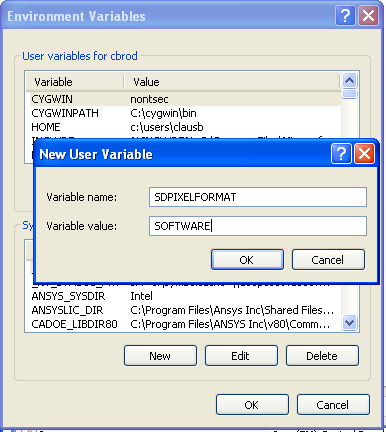 Click sequence in Windows XP:
- Start/Control Panel
- Run
Systemcontrol panel - Select the
Advancedtab - Click "Environment Variables".
- Start/Control Panel
- Click
System and Maintenance, thenSystem - Click
Advanced System Settings; this may pop up a user-access control dialog which you need to confirm - Click
Environment Variables
SDPIXELFORMAT and set the value to SOFTWARE.
Common Lisp in CoCreate Modeling (20 Jun 2009)
 Not many in the audience had heard about our project yet, so there were quite a few
questions after the presentation. Over all those years, we had
lost touch with the Lisp community a bit - so reconnecting to the CL matrix felt just great.
Not many in the audience had heard about our project yet, so there were quite a few
questions after the presentation. Over all those years, we had
lost touch with the Lisp community a bit - so reconnecting to the CL matrix felt just great.
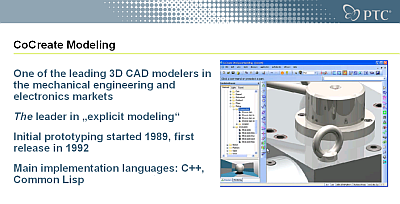 Click on the image to view the presentation. The presentation mentions LOC (lines of code) data;
those include test code.
Previous posts on the European Lisp Symposium:
Click on the image to view the presentation. The presentation mentions LOC (lines of code) data;
those include test code.
Previous posts on the European Lisp Symposium:
- European Lisp Symposium
- Europan Lisp Symposium: Keynote
- European Lisp Symposium: Geeks Galore!
- Sightrunning in Milan
Aggressive predictions (03 May 2008)
So long, and thanks for all the functional fish! (30 Mar 2008)
;; -*-Lisp-*-
;;;;;;;;;;;;;;;;;;;;;;;;;;;;;;;;;;;;;;;;;;;;;;;;;;;;;;;;;;;;;;;;;;;;;;;;;;;;;;
;; Description:  Wrapper to run Frank Buss' functional geometry code
;;               in CoCreate Modeling
;; Author:       Claus Brod
;; Language:     Lisp
;;
;; (C) Copyright 2008 Claus Brod, all rights reserved
;;;;;;;;;;;;;;;;;;;;;;;;;;;;;;;;;;;;;;;;;;;;;;;;;;;;;;;;;;;;;;;;;;;;;;;;;;;;;;
;;

(in-package :clausbrod.de)
(use-package :oli)
(export '(plot-escher))

;; Allow using lambda without quoting it via #' first
;; (No longer required in CoCreate Modeling 2008 and later.)
(defmacro lambda (&rest body)
  `(function (lambda ,@body)))

(defparameter *our-loadpath* *load-truename*)
(load (format nil "~A/functional.lsp"
              (directory-namestring *our-loadpath*)))

;; Modeling-specific plotter function
(defun plot-annotation (p)
  (let ((tempfile (format nil "~A/test.mac" (oli:sd-inq-temp-dir)))
        (scale 500.0))
    (startup::activate-annotation)

    (with-open-file (s tempfile
                       :direction :output :if-exists :supersede)
      (format s "line~%")

      (dolist (line (funcall p '(0 0) '(1 0) '(0 1)))
        (destructuring-bind ((x0 y0) (x1 y1)) line
          (format s "  ~D,~D ~D,~D~%"
                  (* scale (float x0))
                  (* scale (float y0))
                  (* scale (float x1))
                  (* scale (float y1)))))

      (format s "end"))

    (oli:sd-execute-annotator-command
     :cmd (format nil "input '~A'" tempfile))
    (docu::docu_vp :fit_vp)
    (delete-file tempfile)))

;; Shortcut for the Escher fish drawing
(defun plot-escher()
  (plot-annotation *fishes*))
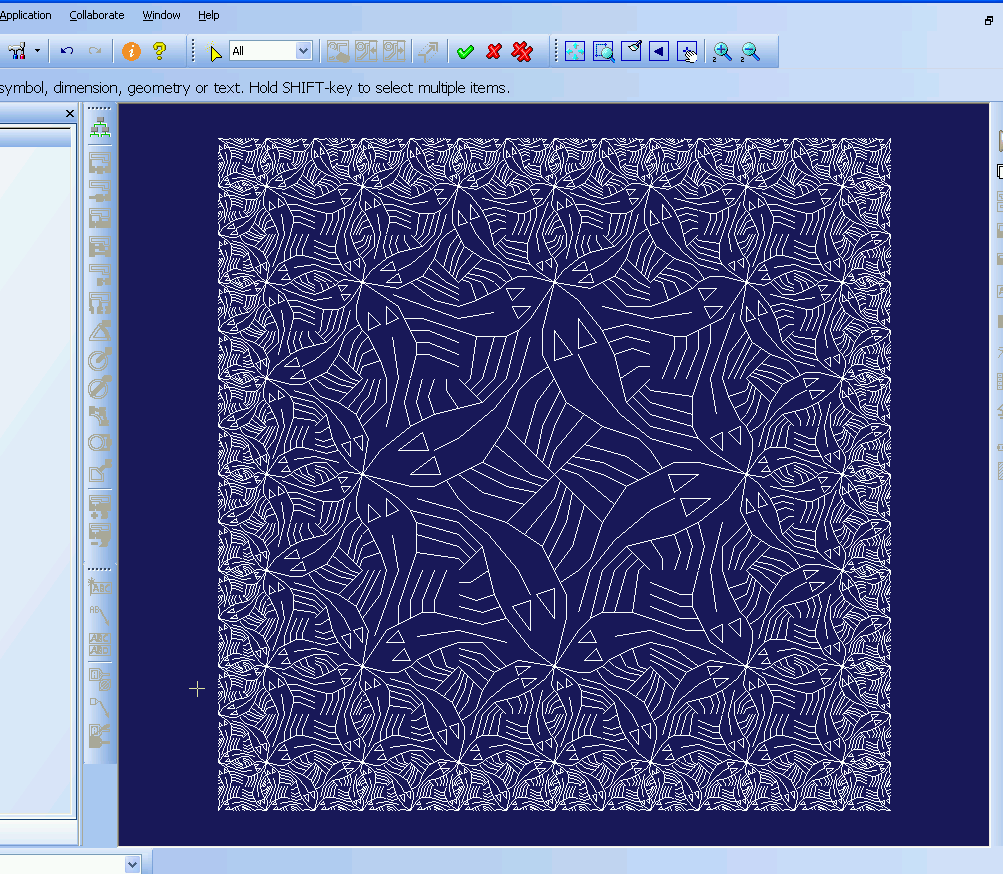
The loader code adds the definition for the lambda macro
which is missing so far in CoCreate Modeling, loads Frank's code, and then adds a
plotter function which creates output in a 2D Annotation window.
Usage instructions:
- Download Frank's code from his site
and save it as
functional.lsp. - Download the loader code and save it into the same directory.
- Load the loader Lisp code into CoCreate Modeling 2007 or higher.
- In the user input line, enter
(clausbrod.de:plot-escher)
Common Lisp at CoCreate (29 Dec 2007)
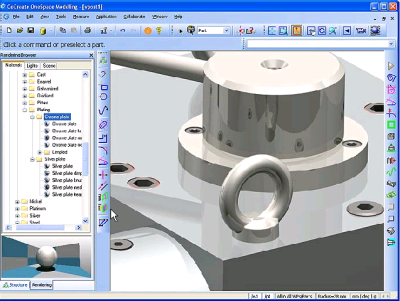 But much of what is said
in the article about Lisp still applies.
The HP Journal article concluded:
But much of what is said
in the article about Lisp still applies.
The HP Journal article concluded:
Common Lisp is also used as a user accessible extension language for HP PE/SolidDesigner. It is a standardized, open programming language, not a proprietary one as in HP PE/ME10 and PE/ME30, and the developers of HP PE/SolidDesigner believe that this will prove to be an immense advantage.SolidDesigner was the original product name; ME10 and ME30 were predecessor products which implemented their own little macro interpreters. Back then, we were a bit cautious about the potential benefits we'd reap, as the product was still in its early days. By now, however, we can say that Common Lisp was a key factor in helping a fairly small team of developers keep pace with the big guns in the industry, due to all the well-known productivity features in Lisp, such as macros, the REPL, or automatic memory management. The HP Journal article describes how we use macros to define a domain-specific language called action routines, which are state machines which guide users through commands. Later, we extended that concept by automatically generating UI for those commands: Using the sd-defdialog macro, application developers can implement full-blown commands in just a few lines of code, without having to write any (or at least hardly any) code for services such as:
- Automatic "macro recording" of commands
- Context-sensitive online help
- UNDO support
- Command customization (commands can be started from toolbars, menus, a user input line, or from our "taskbar")
- Sequence control (dependencies of user inputs on other input)
- UI creation and layout
- Adherence to UI style guides
- Graphical feedback both in the UI and in 3D graphics windows
- Type and range checks for input data
- Automatic unit conversions (imperial to metric etc.)
- Prompting
What's my vector, Victor? (08 Aug 2007)
(line :two_points 100,100 0,0)Common Lisp connoisseurs will notice that this is decidedly non-standard behavior. Those commas aren't supposed to be there; instead, commas serve their purpose in list quoting, particularly in macro definitions. (For a refresher, check out The Common Lisp Cookbook - Macros and Backquote.) And in any other implementation of Lisp, this code would indeed result in an error message such as "comma is illegal outside of backquote". OneSpace Modeling's embedded Lisp, however, will notice a pair of literal numbers and assume that what the user really meant to specify is a structure of type
gpnt2d, which holds x and y slots for the coordinates. And so
what is really evaluated is more like this:
(line :two_points (oli:make-gpnt2d :x 100 :y 100) (oli:make-gpnt2d :x 0 :y 0))
oli is the Lisp package which exports the gpnt2d structure as well as its accessor
and constructor functions.
This explicit syntax is actually required whenever you need to specify coordinates
using non-literals, such as when the actual coordinates are the results of
mathematical calculations. For instance, vector syntax is not recognized
in the following:
(line :two_points (+ 50 50),100 0,0)Now you'll get the expected error message reporting that "a comma has appeared out of a backquote". To make this work, you'd have to say:
(line :two_points (oli:make-gpnt2d :x (+ 50 50) :y 100) 0,0)But despite this limitation, the vector syntax extension was tremendously important for us: Coordinates can be entered in all kinds of places in the user interface where casual users would never suspect that what they are entering is actually thrown into funny engines which the propellerheads at CoCreate call "the Lisp reader" and "the Lisp evaluator".

I'm just a simple property list, I didn't expect the Spanish strinquisition! (19 Jul 2007)
(setf (get 'some-symbol some-indicator) some-value)And to inquire a symbol property, you just say something like
(get 'some-symbol some-indicator).
some-indicator can basically be any type, and so I wasn't sure what my
co-worker meant when he said that he couldn't get strings to work, until
he explained the details to me: He was calling some Lisp-based API
function in our product, and that function returns a property list.
Unfortunately, that property list was special in that somebody had
stuffed a string into it as an indicator, and so the property list
looked somehow like this:
("foo" 42 "bar" 4711)
And indeed, if you now try to inquire the "foo" property using
(get 'some-symbol "foo"), all you get is - nil.
To retrieve a property value, get walks the list and compares each
indicator in the list with "foo" (in this example) - using eq.
From which we can immediately conclude:
- The correct spelling of "property list" is p-e-r-f-o-r-m-a-n-c-e p-r-o-b-l-e-m, as each lookup requires traversing potentially all of the list.
-
eqchecks for object equality, not just value equality. Which means that things like literal (!) strings or characters cannot be indicators!
(get 'some-symbol "foo"), and that "foo" string literal
creates a new string object. While that new object happens to have
the same value as the "foo" string in the property list, it is not the same object.
Indeed, the
Common Lisp HyperSpec
is quite clear on that topic:
"Numbers and characters are not recommended for use as indicators in
portable code since get tests with
eq rather than eql, and
consequently the effect of using such indicators is implementation-dependent."
It all boils down to the simple fact that (eq "foo" "foo") returns nil.
Now hopefully we can fix the API which returned those inadequate property
lists to my co-worker's code, but his code also needs to run in older
and current installations, and so he needed a workaround of some sort.
His first idea was to get the property list and fix it up in a preprocessing
step before using get or getf for lookup, i.e. something like this:
(defun fix-plist(plist old-indicator new-indicator)
  (let ((cnt 0))
    (mapcar
      #'(lambda(item)
          (incf cnt)
          (if (and (oddp cnt) (equal item old-indicator))
              new-indicator item))
      plist)))

(setf my-symbol 42)
(setf (get 'my-symbol "indicator") "value") ;; mess up plist
(print (get 'my-symbol "indicator"))        ;; returns NIL
(print (getf (fix-plist (symbol-plist 'my-symbol) "indicator" :indicator) :indicator))
This works, kind of - but it is actually quite ugly. Sure, with this code, we should be
able to safely move ahead, especially since I also closed that office window in the
meantime, but still: I really hope I'm missing something here. Any other ideas out there?
"Macro" considered harmful (01 May 2007)
- In Lisp, a macro is a piece of code defined by defmacro. Macros in Lisp are a clever way to extend the language. If you want to learn more about this (or about Common Lisp in general, in fact), I recommend Peter Seibel's "Practical Common Lisp" - here's the section on macros.
- CoCreate's 2D package, OneSpace Drafting, has a built-in macro interpreter which can be used to customize and extend the product. Since many OneSpace Drafting migrate from 2D to 3D, i.e. to OneSpace Modeling, they tend to take their nomenclature with them, and so they often call pieces of Lisp customization code a "macro", too.
- In many software packages, users can record the interaction with the product and save the result into files, which are then often called macro files. OneSpace Modeling's recorder is such a mechanism, and so using the word "macro" is kind of natural for many users.
sd-defdialog which is provided by the "Integration Kit" library which
ships with OneSpace Modeling. This API is, in fact, implemented
using defmacro, i.e. sd-defdialog is itself a Lisp macro. So if a user
writes code which builds on sd-defdialog and then calls the result a macro,
he's actually not that far from the truth - although, of course, still
incorrect.
Die Kollegen Könige (21 Mar 2007)
Selbstverherrlichung, so lautete der Vorwurf, und Mißbrauch des Diskussionsforums als Werbeplattform. Ein Totreder sei ich zudem - und einer, der im Forum über andere CAD-Software meckere, "um damit von den eigenen Schwächen abzulenken." Ich hielt es für unwahrscheinlich, daß ich diese Vorwürfe wirklich alle und vor allem in dieser Schärfe verdient hatte - aber solch starken Tobak ignoriert man besser auch nicht einfach so. Es traf sich, daß Urlaub angesagt war, und so ließ ich mir zwei Wochen Zeit, um das in Ruhe zu verdauen und zu begrübeln. Danach nahm ich meinen zumindest zeitweisen Abschied aus dem Forum. Was war geschehen, und warum dieser Schritt? Anwender der Software, die wir bei CoCreate entwickeln und verkaufen, treffen sich in allerlei Foren, und in einigen davon bin ich Stammgast - besonders in den deutschen Foren. "Ich arbeite zwar bei CoCreate, aber ich schreibe das in meiner Freizeit und spreche nicht für die Firma" - das war als Signatur in jedem meiner Wortbeiträge zu lesen. Zwar hat CoCreate nichts gegen meine Beteiligung, aber ich war auch nicht im Auftrag der Firma zugange, sondern privat - ich war schlicht neugierig, wie Kunden mit der Software, die ich mitentwickele, umgehen und welche Erfahrungen sie damit machen. Wie in allen Diskussionsforen, so gab es auch hier ab und an Reibereien. Selten jedoch verspürte ich so viel Gegenwind wie in den letzten Monaten, und zum ersten Mal in über sechs Jahren habe ich nun das Gefühl, daß schon meine bloße Anwesenheit zur Gereiztheit beiträgt. Warum das? Nun, ich kann nicht in die Köpfe derer hineinsehen, die besonders genervt, zuweilen gar aggressiv auf mich reagiert haben. Aber zwei Spekulationen erlaube ich mir.Anwender brauchen schnelle Lösungen, Entwickler gründliche Wenn es im Produkt klemmt, will der Anwender möglichst fix eine Lösung, um weiterarbeiten zu können - selbst wenn die Lösung so hemdsärmlig und kurzlebig wäre, daß sie einem Softwareentwickler Magengrimmen verursacht. Der Entwickler hingegen hat ein Interesse daran, Schwierigkeiten und Tathergang möglichst vollständig aufzuklären: Was ist der Kern des Problems, und welche Beobachtungen haben damit nichts zu tun? War es vielleicht doch ein Anwenderfehler und wie könnte man den in Zukunft vermeiden? Oder ist es ein Fehler in der Software, und wie kann ich den ohne Nebenwirkungen korrigieren, so daß ich mich später nie mehr darum kümmern muß? Also fragt der Entwickler vier- oder fünfmal nach den genaueren Umständen, um die Lage zu sondieren und falsche Vermutungen auszuschließen. Naja, jedenfalls tue ich das gerne. Vielleicht habe mir auf diese Weise so nach und nach das "Totreder"-Image eingehandelt. Kollege Kunde? Wohl doch eher König! Auch wenn die Umgangsformen im Forum kollegial und locker sind, und auch wenn ich tausendmal betone, daß ich das Forum als Privatmann besuche: Aus Kundensicht stehe ich im Zweifel auf der anderen Seite und hafte für all die kleinen oder großen Probleme mit, die der Anwender mit CoCreate-Produkten oder mit CoCreate selbst hatte oder hat. Im Forum geäußerter Werkstolz oder auch der Versuch, falschen Behauptungen entgegenzutreten, wird deswegen besonders kritisch beurteilt.Simple Wahrheiten, denke ich heute - und daß die Vorstellung, mit Kunden feierabends am virtuellen Stammtisch klönen zu können, doch eher naïv war. Und wenn ich noch so darauf beharre, als Privatmann an den Diskussionen teilzunehmen: Das Verhätnis ist und bleibt nun einmal asymmetrisch. Wäre die Betreuung von Foren offizieller Bestandteil meines Jobs, so müßte ich als beauftragter Vertreter meiner Firma mit Angriffen und Auseinandersetzungen leben - und könnte das dann auch gut, denn ich wäre ja nicht persönlich gemeint, oder zumindest könnte ich mir das plausibel einreden. Ich war indes privat und aus Spaß an der Freud' dabei. Am Ende war vom Spaß wenig übrig, also hieß es für mich: Loslassen üben! Die deutschen Foren funktionieren schließlich auch ohne mich prima. Sehr wahrscheinlich besser als zuvor. Bin ich eine Mimose? Gut möglich; ich weiß es nicht. Nur daß mir Auseinandersetzungen im Forum zuweilen die ganze Woche verdorben haben, das weiß ich. Und daß ich das nicht mehr erleben möchte. Was bedeutet das nun für andere Foren? Dort läuft es besser. Vielleicht liegt es daran, daß dort in Englisch diskutiert wird und der Ton schon deswegen ein anderer ist. Jedenfalls werde ich einstweilen Foren wie das internationale CoCreate-Anwenderforum weiter besuchen. Und dieser Blog? Und die FAQ-Seiten, die CoCreate-Produkte betreffen? Nun, auf dieser Website trifft sich offenbar ein anderes Publikum: CAD-Administratoren, Angehörige von Partnerfirmen, Programmierer. Diskussionen, die sich hier ergeben, haben in der Tat eher kollegialen Charakter. Ich mache hier also weiter.
Don't quote me on this (18 Mar 2006)
Let us assume that I'm a little backward and have a peculiar fondness for the DOS command shell. Let us further assume that I also like blank characters in pathnames. Let us conclude that therefore I'm hosed. But maybe others out there are hosed, too. Blank characters in pathnames are not exactly my exclusive fetish; others have joined in as well (C:\Program Files,
C:\Documents and Settings). And when using software, you might be running
cmd.exe without even knowing it. Many applications can run external helper
programs upon user request, be it through the UI or through the application's
macro language.
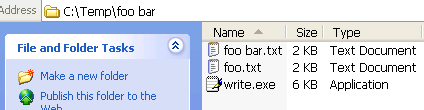 The test environment is a directory
 c:\temp\foo bar which contains
write.exe (copied from the Windows system directory) and two text files, one of
them with a blank in its filename.
Now we open a DOS shell:
C:\>dir c:\temp\foo bar
 Volume in drive C is IBM_PRELOAD
 Volume Serial Number is C081-0CE2

 Directory of c:\temp

File Not Found

 Directory of C:\

File Not Found

C:\>dir "c:\temp\foo bar"
 Volume in drive C is IBM_PRELOAD
 Volume Serial Number is C081-0CE2

 Directory of c:\temp\foo bar

03/18/2006  03:08 PM    <DIR>          .
03/18/2006  03:08 PM    <DIR>          ..
01/24/2006  11:19 PM             1,516 foo bar.txt
01/24/2006  11:19 PM             1,516 foo.txt
03/17/2006  09:44 AM             5,632 write.exe
               3 File(s)          8,664 bytes
               2 Dir(s)  17,448,394,752 bytes free
Note that we had to quote the pathname to make the DIR command work.
Nothing unusual here; quoting is a fact of life for anyone out there
who ever used a DOS or UNIX shell.
Trying to start write.exe by entering c:\temp\foo bar\write.exe in the
DOS shell fails; again, we need to quote:
And if we want to loadC:\>"c:\temp\foo bar\write.exe"
foo bar.txt into the editor, we need to quote
the filename as well:
Still no surprises here. But let's suppose we want to run an arbitrary command from our application rather than from the command prompt. The C runtime library provides the system() function for this purpose. It is well-known that under the hoodC:\>"c:\temp\foo bar\write.exe" "c:\temp\foo bar\foo bar.txt"
system actually runs cmd.exe to do its job.
#include <stdio.h>
#include <process.h>

int main(void)
{
  char *exe = "c:\\temp\\foo bar\\write.exe";
  char *path = "c:\\temp\\foo bar\\foo bar.txt";

  char cmdbuf[1024];
  _snprintf(cmdbuf, sizeof(cmdbuf), "\"%s\" \"%s\"", exe, path);

  int ret = system(cmdbuf);
  printf("system(\"%s\") returns %d\n", cmdbuf, ret);
  return 0;
}
When running this code, it reports that system() returned 0, and write.exe
never starts, even though we quoted both the name of the executable and
the text file name.
What's going on here? system() internally runs cmd.exe like this:
Try entering the above in the command prompt: No editor to be seen anywhere! So when we runcmd.exe /c "c:\temp\foo bar\write.exe" "c:\temp\foo bar\foo bar.txt"
cmd.exe programmatically, apparently it parses its input
differently than when we use it in an interactive fashion.
I remember this problem drove me the up the freakin' wall when I first encountered
it roughly two years ago. With a lot of experimentation, I found the right
magic incantation:
Note that I quoted the whole command string another time! Now the executable actually starts. Let's verify this in the command prompt window: Yes, something like_snprintf(cmdbuf, sizeof(cmdbuf), "\"\"%s\" \"%s\"\"", exe, path); // originally: _snprintf(cmdbuf, sizeof(cmdbuf), "\"%s\" \"%s\"", exe, path);
cmd.exe /c ""c:\temp\foo bar\write.exe" "c:\temp\foo bar\foo bar.txt""
does what we want.
I was reminded of this weird behavior when John Scheffel, long-time user of our flagship
product OneSpace Designer Modeling and maintainer of the international
CoCreate user forum, reported funny
quoting problems when trying to run executables from our app's built-in Lisp interpreter.
John also found the solution and documented it in a Lisp version.
Our Lisp implementation provides a function called sd-sys-exec, and you need to
invoke it thusly:
Kudos to John for figuring out the Lisp solution. Let's try to decipher all those quotes and backslashes in the(setf exe "c:/temp/foo bar/write.exe") (setf path "c:/temp/foo bar/foo bar.txt") (oli:sd-sys-exec (format nil "\"\"~A\" \"~A\"\"" exe path))
format statement.
Originally, I modified his solution slightly
by using ~S instead of ~A in the format call and thereby saving one level
of explicit quoting in the code:
(format nil "\"~S ~S\"" exe path))This is much easier on the eyes, yet I overlooked that the
~S format specifier
not only produces enclosing quotes, but also escapes any backslash characters
in the argument that it processes. So if path contains a backslash (not quite
unlikely on a Windows machine), the backslash will be doubled. This works
surprisingly well for some time, until you hit a UNC path which already starts
with two backslashes. As an example, \\backslash\lashes\back turns into
\\\\backslash\\lashes\\back, which no DOS shell will be able to grok anymore.
John spotted this issue as well. Maybe he should be writing these blog entries,
don't you think?  From those Lisp subtleties back to the original problem:
I never quite understood why the extra level of quoting is necessary for
From those Lisp subtleties back to the original problem:
I never quite understood why the extra level of quoting is necessary for
cmd.exe, but apparently, others have been in the same mess before. For example,
check out
this XEmacs code
to see how complex correct quoting can be. See also an online version of
the help pages for CMD.EXE
for more information on the involved quoting heuristics applied by the shell.
PS: A very similar situation occurs in OneSpace Designer Drafting as well
(which is our 2D CAD application). To start an executable write.exe in a directory
c:\temp\foo bar and have it open the text file c:\temp\foo bar\foo bar.txt,
you'll need macro code like this:
LET Cmd '"C:\temp\foo bar\write.exe"'
LET File '"C:\temp\foo bar\foo bar.txt"'
LET Fullcmd (Cmd + " " + File)
LET Fullcmd ('"' + Fullcmd + '"')  { This is the important line }
RUN Fullcmd
Same procedure as above: If both the executable's path and the path of
the data file contain blank characters, the whole command string which
is passed down to cmd.exe needs to be enclosed in an additional
pair of quotes...
PS: See also http://blogs.msdn.com/b/twistylittlepassagesallalike/archive/2011/04/23/everyone-quotes-arguments-the-wrong-way.aspx
and http://daviddeley.com/autohotkey/parameters/parameters.htm
http://xkcd.com/1638/
-- ClausBrod - 27 Mar 2016
Two minute warning (16 Mar 2006)
Software is a freaky thing. I still don't know how to explain what it is to my mum and dad. I could tell them about ones and zeroes and how layer upon layer of hardware and software build on each other until they finally form what they see on a computer screen or in a digital camera. But I'm not overly confident I'd be able to bring across how this stuff really works, partially because I hardly think about the inner workings of computer systems anymore. The von Neumann architecture is so deeply engraved into Joe Developer's reasoning and mindset that it becomes an almost subconscious fundament of our daily work. But many of those who use computers every day never really understand how this gadget works. They usually get by because over time the software industry has developed UI metaphors which shield users from the internal complexity. Until something unexpected happens - such as an application crash. Once upon a time in a reality not too far away, a Japanese user started seeing application crashes. The bug report through which we learned about his problems did not really complain about individual bugs or situations in which the crashes occurred. Instead, he requested to add a feature to the software so that it would alert the user before a crash would occur so that he'd have the chance to save his data and exit before the crash actually happened. Now this was not a request to add a top-level exception handler which kicks in when a crash occurs, reports the issue to the user and makes a last-ditch effort to save data in memory. We already had that in the application. No, what the customer really wanted our application to do was to predict that a crash was looming in the near future. My brain starts to hurt whenever I think about this request. After all, a crash is usually caused by a hitherto undetected bug in the code, i.e. by an issue which neither we as the programmers nor the software itself know about. Being able to predict a crash which is due to a bug in our code is more or less equivalent to knowing that the bug exists, where it is located, what the user's next action will be, and whether that course of action would lead him into the "danger zone". I'll ignore the bit about predicting the user's action for a moment; but if either we or the software already knows about the bug, why not simply fix it in the first place rather than ceremonially announcing it to the user? (Did I miss something? Does any of the more recent CPUs have a clairvoyance opcode that we could use? )
It took me only a short while to explain this to our support folks, but then,
they are sufficiently versed with software that they kind of "got it" naturally,
even though most of them do not develop any software. I don't think, however,
that we ever succeeded to communicate this properly to the customer.
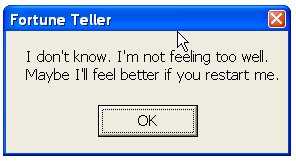 Maybe I even understand the customer. He was probably thinking he
was kind of generous to us; after all, he was willing to accept that any
kind of software inevitably has some bugs, some of which even cause crashes,
and that there is no practical way of dealing with this other than
using the software and fixing the issues one by one.
But at the very minimum, he wanted to be warned. I mean, how
hard can this be, after all! Even cars alert their drivers if there is a problem
with the car which should be taken care of in a garage as soon as possible.
Most of these problems, however, are not immediately fatal. The car
continues to work for some time - you don't have to stop it right away
and have it toed to the garage, but can drive it there yourself, which is
certainly more convenient.
What seems to be a fairly simple idea to a customer, is a nerve-wrecking
perspective for a developer. There is really no way to predict the
future, not even in a computer program; this is what the halting problem
teaches us. However, what seems obvious to a developer, sounds like a
lame excuse to someone who is not that computer-savvy.
But then, maybe there are ways to monitor the health of software and
the data which it processes, and maybe, based on a lot of heuristics, we
could even translate those observations into warnings for users without
causing too many false alarms...
Maybe I even understand the customer. He was probably thinking he
was kind of generous to us; after all, he was willing to accept that any
kind of software inevitably has some bugs, some of which even cause crashes,
and that there is no practical way of dealing with this other than
using the software and fixing the issues one by one.
But at the very minimum, he wanted to be warned. I mean, how
hard can this be, after all! Even cars alert their drivers if there is a problem
with the car which should be taken care of in a garage as soon as possible.
Most of these problems, however, are not immediately fatal. The car
continues to work for some time - you don't have to stop it right away
and have it toed to the garage, but can drive it there yourself, which is
certainly more convenient.
What seems to be a fairly simple idea to a customer, is a nerve-wrecking
perspective for a developer. There is really no way to predict the
future, not even in a computer program; this is what the halting problem
teaches us. However, what seems obvious to a developer, sounds like a
lame excuse to someone who is not that computer-savvy.
But then, maybe there are ways to monitor the health of software and
the data which it processes, and maybe, based on a lot of heuristics, we
could even translate those observations into warnings for users without
causing too many false alarms...
Comment dit-on "knapsack" en français? (01 Mar 2006)
This week, a customer of our software asked a seemingly innocent question; given a set of tools of various lengths, he wanted to find subsets of those tools which, when combined, can be used to manufacture a screw of a given length. From the description, I deduced that we were talking about a variation of the subset sum problem which is a special case of the knapsack problem. Faint memories of my time at university arose; I couldn't resist the weird intellectual tickle. Or maybe it was just the beginning of my pollen allergy for this year Anyway, I searched high and low on my
quest to reacquire long-lost knowledge.
One of the weirder search results was a TV show called
Des chiffres et des lettres
which has been running for ages now on French TV. In that show, they
play a game called "Le compte est bon" which is actually a variation
of the subset sum problem! The candidates are supposed to solve this puzzle
in about a minute or so during the show. Wow - these French guys must
be math geniuses!
Anyway, I couldn't help but try a subset sum algorithm in Lisp.
I ran it both using CLISP and the implementation of Lisp provided in
CoCreate OneSpace Modeling. I started to collect
some benchmark results for CLISP, comparing interpreted and compiled
code to get a better feeling for the kind of improvements I can expect
from the CLISP compiler. In the case of CLISP, the compiler improves
runtime by roughly an order of magnitude. See the discussion of the algorithm for detailled results.
https://xkcd.com/287/
-- ClausBrod - 01 Sep 2017
Blame CoCreate, for instance (14 Feb 2006)
The company I work for is called CoCreate. The name was chosen because the company's mission is all about collaboratively creating things. That's all nice and dandy, but I guess the team who picked the name didn't include a programmer, and so they overlooked something pretty obvious which causes mild confusion every now and then. Most programmers, when confronted with our company name, think of COM. After all, one of the most important functions in all of the COM libraries prominently displays our company name: CoCreateInstance. Now, if a programmer thinks about COM (and hence software) when she hears about us, that's probably fine, because, after all, we're in the business to make and sell software. However, customers are not necessarily that technology-savvy, nor should they have to be. A while ago, a customer complained that our software was sloppy because it wouldn't uninstall itself properly and leave behind traces in the system. Our installer/uninstaller tests didn't seem to confirm that. So we asked the customer why he thought we were messing with his system. "Well", he said, "even after I uninstall your stuff, I still get those CoCreate error messages."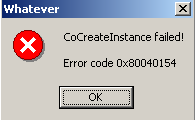 The customer sent a screenshot - it showed a message box,
displayed by an application which shall remain unnamed, saying
that "CoCreateInstance failed" and mumbling some COM error
codes!
It took us a while to explain to the customer that no, we
did not install this CoCreateInstance thing on the system,
and that it is a system function, and if we actually tried to
uninstall it along with our application as he requested (kind of),
he wouldn't be terribly happy with his system any longer, and
that the other app was actually trying to report to the customer that
it had found a problem with its COM registration, and that this should
be looked after, not our uninstaller. Phew.
Now if only we had the time-warping powers of the publishers
of "The Hitchhiker's Guide To The Galaxy", we'd send our
company marketing materials back into time before Microsoft invented
COM, and then sue the living daylights out of them. Well, if we were
evil, that is
My memory took a little longer to swap back in, but while writing
the above, it dawned on me that this incident wasn't the only one of
its kind: Somebody had upgraded to a new PC and installed all applications
except CoCreate's. Then, while syncing to his Palm Pilot, he got
an "OLE CoCreateInstance Failed" error message, and started to
search high and low on his shiny new PC for traces of CoCreate
applications or components.
Puzzled, he posted to a newsgroup, and I replied with tongue-in-cheek:
The customer sent a screenshot - it showed a message box,
displayed by an application which shall remain unnamed, saying
that "CoCreateInstance failed" and mumbling some COM error
codes!
It took us a while to explain to the customer that no, we
did not install this CoCreateInstance thing on the system,
and that it is a system function, and if we actually tried to
uninstall it along with our application as he requested (kind of),
he wouldn't be terribly happy with his system any longer, and
that the other app was actually trying to report to the customer that
it had found a problem with its COM registration, and that this should
be looked after, not our uninstaller. Phew.
Now if only we had the time-warping powers of the publishers
of "The Hitchhiker's Guide To The Galaxy", we'd send our
company marketing materials back into time before Microsoft invented
COM, and then sue the living daylights out of them. Well, if we were
evil, that is
My memory took a little longer to swap back in, but while writing
the above, it dawned on me that this incident wasn't the only one of
its kind: Somebody had upgraded to a new PC and installed all applications
except CoCreate's. Then, while syncing to his Palm Pilot, he got
an "OLE CoCreateInstance Failed" error message, and started to
search high and low on his shiny new PC for traces of CoCreate
applications or components.
Puzzled, he posted to a newsgroup, and I replied with tongue-in-cheek:
Let me explain: When we kicked off CoCreate as a company, we sat together and thought about awareness strategies for the new company. So we called our buddies from Microsoft and asked them to name some API functions after us, and in exchange we would port our software to Windows NT. Neat scheme, and as you discovered on your system, the cooperation between the two companies worked just fine. [... skipping explanation of the technical issue and hints on how to fix registry issue on the system ...] The next step for CoCreate towards world domination will be to talk to some of our buddies in, say, Portugal, and offer them to develop a Portugese version of our application if they name their country after us.Would I get away with a response like this if I was a support engineer? Maybe not. One more thing to like about being a software developer
(Everybody in the newsgroup had a good chuckle back then.)
I'm so special (11 Feb 2006)
  int fortytwo = 42;

  int shatter_illusions(void)
  {
    return fortytwo;
  }

  void quelle_surprise(void)
  {
    int fortytwo = 4711;
    printf("shatter_illusions returns %d\n", shatter_illusions());
  }
A seasoned C or C++ programmer will parse this code with his eyes shut and tell
you immediately that quelle_surprise will print "42" because shatter_illusions()
refers to the global definition of fortytwo.
Meanwhile, back in the parentheses jungle:
  (defvar fortytwo 42)

  (defun shatter-illusions()
    fortytwo)

  (defun quelle-surprise()
    (let ((fortytwo 4711))
      (format t "shatter-illusions returns ~A~%" (shatter-illusions))))
To a C++ programmer, this looks like a verbatim transformation of the code above
into Lisp syntax, and he will therefore assume that the code will still answer "42".
But it doesn't: quelle-surprise thinks the right answer is "4711"!
Subtleties aside, the value of Lisp variables with lexical binding is determined
by the lexical structure of the code, i.e. how forms are nested in each other.
Most of the time, let
is used to establish a lexical binding for a variable.
Variables which are dynamically bound lead a more interesting life: Their
value is also determined by how forms call each other at runtime.
The defvar
statement above both binds fortytwo to a value of 42 and declares the variable as
dynamic or special, i.e. as a variable with dynamic binding. Even if code
is executed which usually would bind the variable lexically, such as
a let form, the variable will in fact retain its dynamic binding.
"Huh? What did you say?"
-
defvardeclaresfortytwoas dynamic and binds it to a value of 42. - The
letstatement inquelle-surprisebindsfortytwoto a value of 4711, but does not change the type of binding! Hence,fortytwostill has dynamic binding which was previously established bydefvar. This is true even thoughletusually always creates a lexical binding. -
shatter-illusions, when called, inherits the dynamic bindings of the calling code; hence,fortytwowill still have a value of 4711!
defvar as follows:
(defmacro defvar (var &optional (form nil form-sp) doc-string)
  `(progn (si:make-special ',var)
          ,(if (and doc-string *include-documentation*)
               `(si:putprop ',var ,doc-string 'variable-documentation))
          ,(if form-sp
               `(or (boundp ',var)
                    (setq ,var ,form)))
          ',var))
In the highlighted form, the variable name is declared as special,
which is equivalent with dynamic binding in Lisp.
This effect is quite surprising for a C++ programmer. I work with both Lisp and
C++, switching back and forth several times a day, so I try to minimize
the number of surprises a much as I can. Hence, I usually stay away from
special/dynamic Lisp variables, i.e. I tend to avoid defvar and friends
and only use them where they are really required.
Unfortunately, defvar and defparameter are often recommended in Lisp
tutorials to declare global variables. Even in these enlightened
times, there's still an occasional need for a global variable, and if
you follow the usual examples out there, you'll be tempted to quickly add a
defvar to get the job done. Except that now you've got a dynamically bound
variable without even really knowing it, and if you expected this variable
to behave like a global variable in C++, you're in for a surprise:
  > (print fortytwo)
  42
  42
  > (quelle-surprise)
  shatter-illusions returns 4711
  NIL
  > (shatter-illusions)
  42
  > (print fortytwo)
  42
  42
So you call
shatter-illusions once through quelle-surprise, and it tells
you that the value of the variable fortytwo, which is supposedly global,
is 4711. And then you call the same function again, only directly, and it
will tell you that this time fortytwo is 42.
The above code violates a very useful convention in Lisp programming which
suggests to mark global variables with asterisks
(*fortytwo*). This, along with the guideline that global variables should
only be modified using setq and setf rather than let, will avoid
most puzzling situations
like the above. Still, I have been confused by the dynamic "side-effect"
of global variables declared by defvar often enough now that I made it
a habit to question any defvar declarations I see in Lisp code.
More on avoiding global dynamic variables next time.
Fingerpointing at smart pointers (31 Dec 2005)
In an ATL COM client which uses#import to generate wrapper code for objects,
I recently tracked down a subtle reference-counting issue down to this single line:
IComponentArray *compArray = app->ILoadComponents();This code calls a method
ILoadComponents on an application object which returns
an array of components. Innocent-looking as it is, this one-liner caused me
quite a bit of grief. If you can already explain what the reference counting
issue is, you shouldn't be wasting your time reading this blog. For the rest
of us, I'll try to dissect the problem.
(And for those who don't want to rely on my explanation: After I had learnt
enough about the problem so that I could intelligently feed Google with
search terms, I discovered a Microsoft
Knowledge Base
article on this very topic. However, even after reading the article, some details
were still unclear to me, especially since I don't live and breathe ATL all day.)
The #import statement automatically generates COM wrapper functions. For
ILoadComponents, the wrapper looks like this:
inline IComponentArrayPtr IApplication::ILoadComponents () {
    struct IComponentArray * _result = 0;
    HRESULT _hr = raw_ILoadComponents(&_result);
    if (FAILED(_hr)) _com_issue_errorex(_hr, this, __uuidof(this));
    return IComponentArrayPtr(_result, false);
}
IComponentArrayPtr is a typedef-ed template instance of
_com_ptr_t.
The constructor used in the code snippet above will only call AddRef
on the interface pointer if its second argument is true. In our case, however,
the second arg is false, so AddRef will not be called. The IComponentArrayPtr
destructor, however, always calls Release().
Feeling uneasy already? Yeah, me too. But let's follow the course of action a little
bit longer. When returning from the wrapper function, the copy constructor of the
class will be called, and intermediate IComponentArrayPtr objects will be
created. As those intermediate objects are destroyed, Release() is called.
Now let us assume that the caller looks like above, i.e. we assign the return value
of the wrapper function to a CComPtr<IComponentArray> type. The sequence
of events is as follows:
- Wrapper function for
ILoadComponentsis called. - Wrapper function calls into the COM server. The server returns
an interface pointer for which
AddRef()was called (at least) once inside the server. The reference count is 1. - Wrapper function constructs an
IComponentArrayPtrsmart pointer object which simply copies the interface pointer value, but does not callAddRef(). The refcount is still 1.
CComPtr<IComponentArray> components = app->ILoadComponents();
ILoadComponents returns an object of type IComponentArrayPtr. At this
point, the reference count for the interface is 1 (see above). The
The compiler casts IComponentArrayPtr to IComponentArray*, then calls the
CComPtr assignment operator which copies the pointer and calls AddRef on it.
The refcount is now 2. At the completion of the statement, the temporary
IComponentArrayPtr is destroyed and calls Release on the interface. The
refcount is 1. Just perfect.
Now back to the original client code:
IComponentArray *compArray = app->ILoadComponents();Here, we assign to a "raw" interface pointer, rather than to a
CComPtr,
When returning from the wrapper function,
the refcount for the interface is 1. The compiler casts IComponentArrayPtr
to IComponentArray* and directly assigns the pointer. At the
end of the statement (i.e. the end of the "full expression"), the temporary
IComponentArrayPtr is destroyed and calls Release, decrementing the
refcount is 0. The object behind the interface pointer disappears, and
subsequent method calls on compArray will fail miserably or crash!
So while ATL, in conjunction with the compiler's #import support,
is doing its best to shield us from the perils of reference counting
bugs, it won't help us if someone pulls the plug from the ATL force-field
generator by incorrectly mixing smart and raw pointers.
This kind of reference counting bug would not have occurred if I had
used raw interface pointers throughout; the mismatch in calls to AddRef
and Release would be readily apparent in such code. However, those
smart pointers are indeed really convenient in practice because
they make C++ COM code so much simpler to read. However, they do not
alleviate the programmer from learning about the intricacies of
reference counting. You better learn your IUnknown before you do
CComPtr.
This reminds me of Joel Spolsky's
The Perils of JavaSchools,
which is soooo 1990 (just like myself), but good fun to read.
to top
Revisions: | r1.24 | > | r1.23 | > | r1.22 | Total page history | Backlinks
Blog.DefinePrivatePublicCoCreateModeling moved from Blog.DefinePrivatePublicOneSpaceModeling on 28 Jul 2009 - 20:31 by ClausBrod - put it back
 Blog
Blog